Archive for the ‘Scouting’ Category
When you set a goal, it should be challenging. Otherwise, what’s the point? If the goal is easily, quickly obtained, then it’s not a good goal. Don’t waste your time “working” to meet a goal that you can do with your eyes closed. When you’re going to go to all of the trouble of saying you have a goal, working towards it … make sure that it’s worth the effort so that when you get there, it’s going to be worth the effort to celebrate!

“Every great dream begins with a dreamer. Always remember, you have within you the strength, the patience, and the passion to reach for the stars to change the world.” — Harriet Tubman
In business, it has been called a Big Hairy Audacious Goal. If you can get every member of your organization to buy in to a seemingly impossible goal … then you can achieve amazing things.

will.i.am
Setting big goals isn’t a new idea, of course. It’s a pop culture phenomenon, too: will.i.am got NASA to help him premiere his new song, “Reach for the Stars,” which became the first song broadcast from another planet when it was beamed back from Mars this year. Here’s a sample of the lyrics:
Why they say the sky is the limit
When I’ve seen the footprints on the moon
And I know the sky might be high
But baby it ain’t really that high
And I know that mars might be far
But baby it ain’t really that far
Let’s reach for the stars
What’s this got to do with the Ultimate Family Event, you ask? EVERYTHING!
Our family tradition was to go camping every Memorial Day in the sequoias. There’s a pair of adjacent National Parks, the Sequoia National Park and Kings Canyon National Park, that are about 5 hours north of Los Angeles. Our family built big memories there. When we went camping one year, we had to set Lauren’s playpen up in a snowdrift (it is not warm in May at 7,000 feet!). Another year, the kids got their first (unsuccessful) fishing experience. We explored caves. We saw really, really big trees. Every year we did it, and every year it was great.

The Mowry family, ready to GO! Kings Canyon National Park, 1995.
In 1995, I wanted the family to go hiking. By this time, Christopher was well into Boy Scouts, Michael was a Bear in Cub Scouts … and our Cub Scout Pack regularly went hiking locally. But it was our big annual vacation in the Sequoias, and I wanted to push the envelope.
Two things happened during this vacation that became legendary in the family. The first was Velda’s immortal announcement during our first dinner, “Look at that big dog!” The “dog,” of course, was not a “dog,” it was a “deer.” And so began Velda’s reputation for, uh, having trouble identifying wildlife.
The important thing that happened, though, was that we had a wonderful hiking experience.
It was in Kings Canyon National Park, and it started, appropriately enough, at “Road’s End.” From there, we did a 9 mile loop hike to Mist Falls, which is the entrance to Paradise Valley. Sounds gorgeous, right? Yup.

John Muir is famous for his love of and passion for the California wilderness. His packing advice couldn’t have been simpler: “Throw a loaf of bread and a pound of tea in an old sack and jump over the back fence.” I don’t think he was traveling with a 5 year old, however.
Here’s the hitch: Lauren was 5 years old.
5 years old. 9 mile hike. At altitude. Really? Yup. Let’s reach for the stars.
That was our family’s Big Hairy Audacious Goal. We began talking about this hike weeks in advance. The kids were always excited to go to the Sequoias, and were absolutely excited about the big hike we had planned. They wanted to go. They wanted to see Mist Falls. We were going to conquer a 9 mile hike, and we were going to do it together with a kindergartner.
The morning went great. The forest was lovely, the trail very well maintained, the King’s River was splashing merrily along with snow melt. It was really a gorgeous hike. We had lunch on the granite rocks overlooking Mist Falls.
And then it began to rain. We were about 4 miles from the car. This was a great mountain rain, with a quick temperature drop of 30* and grand claps of thunder in the thin mountain air that sounded like the world was ending. There were guys on the trail in shorts & a t-shirt that were fighting hypothermia as they ran for their cars … which were 4 miles away. “Road’s End,” remember?
The Scouting motto was and is key to our preparation for family outings. Be prepared, indeed. We had layers of warm clothing, and we had ponchos for everyone. The temperature was not an issue, and the rain was not an issue.
Except for our kindergartner. The poncho was actually too long for her short legs. She had to be very careful; it was often a trip hazard when walking uphill. She had to hold the poncho up, or it would drag on the ground. No problem. She looked like a yellow ghost as she chewed up miles of trail in the rain.
Did she hike 9 miles — 4 in the rain? Absolutely. There was never really a question in anyone’s mind, and the family achieved that big, impossible goal.

With poncho held high, the Mist Falls trek proved to be one of the best parts of this great family vacation in Kings Canyon National Park.

Philmont’s most famous landmark, the Tooth of Time.
When I started getting in shape to go to Philmont, I really didn’t know what I was doing. I decided that I could lose weight if I started running … something I had never been serious about. I had run track in high school — but I mean that in the loosest possible sense. I ran, I was in high school. I was pitiful. The only team point I ever scored was when I finished 5th in a 5 man race. I ran the 2 mile. No idea what my times were … who would keep track of such a thing? The stop watches were already off when I finished. Every time.

Assistant Referee, 2002
Move forward many years, and Velda volunteered me to be a referee for Christopher’s soccer team, a part of the AYSO program. (Many referees begin this way!) I told myself that it was my exercise program … and it was better than nothing. But it did not lead to healthier lifestyle choices, and I remained overweight. I could run as fast as a 9 year old dribbling the ball, though, so I was OK. This would have been 1992.
Ten years later, I was a better, faster referee, but I still needed to shed 60 pounds. When I first hit the road to begin running … I couldn’t run a mile. Long before then, I was a wheezing mess. I kept at it, though, in my sweats and my Reebok cross trainers … and kept at it. I actually ran enough miles in those Reeboks that I wore the soles of the shoes away to a severe angle (come to find out, I’m an underpronator. Who knew?). When I finally bought new shoes, I found I could not even walk without pain, as my tendons wouldn’t let the soles of my feet land flat as I ran anymore. Oops. Back to walking.
And then I was a fitness runner. As I got more serious about my running, I got more serious about my gear, eventually switching to good shoes, a GPS system, and (perhaps most importantly) a simple spreadsheet log of what I had done. I began to keep a daily record of my runs after I was well into my fitness program; in February ’03 I was able to do 10 minute miles for 3 mile runs on a good day (on a bad day, not so much). I split the longer runs into shorter intervals, and kept track of my time for every interval. I didn’t have that in high school … now, I became obsessed with it.
I believe that this daily ritual is the most important reason that my running succeeded: I always knew how fast I was running, and I wouldn’t let myself slow down. I pushed. I was in a race with myself, and I celebrated every time I broke my record for an interval by coloring that square in my spreadsheet a special color! Silly, but it worked. I focused on turning the spreadsheet green, one interval at a time, one day at a time.
On my last run before Philmont, I did my 3 miles with an average mile pace of 9:51, my best yet. My weight? Back to what it was in college.
Philmont was GREAT … my life was GREAT. I felt better than I had in years. And suddenly … I had achieved my goal — and didn’t have another. That just wouldn’t do. It was about then that I talked to a great lady, Linda Johnson. Linda was a serious runner — she was doing 9 miles as a daily run. Linda worked with me as a sales rep, and she taught me the value of multiplication.
Linda asked what I was running, and I told her I was doing 3 miles most days. She said great, if you can run 3 miles, you can run 6 miles (and I could!). And if I could run 6 miles, Linda said I could run 12, and that’s almost a half marathon. And if I could run a half marathon, she proudly said, I could run a marathon.
A marathon? WHAT?
Remember where I started: I could not run a mile. And here I was a year later, with a real runner telling me that I could do a marathon. Unbelievable.
And then I did it.
Here’s your takeaway:
1. Get a goal.
2. Keep track of your progress versus that goal.
3. Celebrate your progress towards your goal.
4. Achieve that goal.

January 18, 2004. San Diego Marathon, now called the Carlsbad Marathon. 26.2 beautiful Southern California miles!
I grew up on a small family farm in rural Missouri. My world was pretty small … a trip to St Joseph, 32 miles away, was a very big deal.
I joined Scouting while in second grade, and loved reading Boy’s Life and dreaming big dreams about what I would do in Scouting. One of my biggest dreams was to go on the ultimate Scouting adventure: backpacking at tbe Philmont Scout Reservation, near Cimarron, New Mexico. Understand, my Troop never went backpacking. Such a trip was way, way beyond the resources of my family, and of my troop. It simply wasn’t going to happen. But the dream … did not die.

1970, after receiving my God & Country award. I was 14 years old, and wouldn’t have lasted on the trails of Philmont, even if I could have gotten there.
It’s important to have goals. Really, really big goals. You need to get big ones.
I wrote in a recent post about “The 2012 Plan.” This plan took 15 years to complete, and the best part was that I didn’t have to do the work! I graduated from Mizzou in 1978. Beginning in 1997, it was up to the wife and 3 kids for them to earn their degrees. 15 years and 5 degrees later, we deserve the family celebration that’s just a few days away.
I’m sure that Velda will say that the worst part of the Plan was that the family had to eat my cooking while she was studying for her Masters in Nursing from UCLA. I never understood what the problem was: not only am I proficient in the kitchen, I prepare dishes that Velda never will. And the kids didn’t complain (too much) about the 3 dishes they said I prepared … not even the Hamburger Helper! Good news: we all survived!
No one will mistake what I do for the artistry that Velda performs in the kitchen. But the choice to miss her cooking for a few meals in order for her to achieve one of her big goals was not a choice at all. She’s been happy as a nurse practitioner ever since.
But, back to Philmont. I did not reach that goal until I was 46. But that’s really not the story.

Climbing the Tooth of Time is a part of the Philmont experience that no backpacker should miss!
The problem for me was that Boy Scouts are serious about backpacking, and, thank goodness, they expect the boys and leaders to be in shape. You have to make a goal weight based on your height … or you don’t go on the trail. Once I understood that my boys wanted to go to Philmont, I had to prepare myself. And lose about 60 pounds.
I’ve never been a gym rat. Velda had achieved great success with Weight Watchers, but that didn’t seem like my thing, either. I started doing what I had not done since high school: I decided to run.
The problem, though, was that I wasn’t able to run any distance at all. I started walking in my cross trainer Reeboks, wearing sweats … and worked myself up from there. Eventually, I could run 2 miles without walking. That was a very big day, let me assure you! But I was not nearly done.
I fixed my diet (a calorie-counting shake from Costco in the morning, a banana and an apple for snacks, Subway for lunch, and a sensible dinner from Velda. I kept pushing. And the weight fell off. Running became a daily obsession, and I eventually got up to 7-mile runs on the weekends. I faithfully kept a running log every day, and used a GPS system to track my times for each segment of the runs I did.
By the time I went to Philmont with my boys, I was in the best shape of my life. I had lost 70 pounds. Hitting the trail with 50+ pounds on my back for a 10-day, 52-mile trek was still nothing to sneeze at, but I was ready. I was 46, but keeping up with 17-year old boys was not a problem. We sat on the Tooth of Time at sunrise, and we proudly proclaimed “Go Big or Go Home” while we reveled in the burro races, the trail food, and a feeling of self reliance that’s very difficult to discover if you’re sitting on your sofa.
It was the most personally fulfilling thing I have done in Scouting. And I got there because I had a goal. A big one.

We made it: Michael Mowry, Christopher Mowry, myself, and Lyle “The Destroyer” Wohlfarth with the map he was in charge of for all 52 miles. 2003.
August 1, 2012 is the 100th anniversary of the first Eagle Scout Board of Review. I am proud to be an Eagle Scout.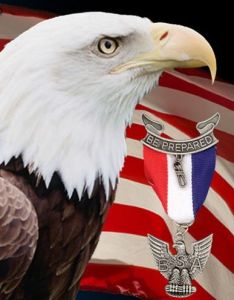
There are great resources to explain the Eagle award and what it represents. One President of the United States earned the award … as did the first man on the moon, a current Supreme Court Justice and many, many more noteworthy individuals. I celebrate their accomplishment, and ask you to consider a few facts about Eagle Scouts:
- They are significantly more likely to have worked to solve problems in their community than non-Scouts.
- Eagle Scouts are 55 percent more likely than non-Scouts to have held a leadership position at their workplace.
- They are more likely to be active readers.
- Eagles are 72% more likely to attend live entertainment events than non-Scouts.
- Eagle Scouts are 100% more likely than non-Scouts to have a designated family meeting place in the event of an emergency.
- Eagle Scouts are 45% more likely than non-Scouts to agree they always treat people of other religions with respect.
- Eagle Scouts are 34% more likely than non-Scouts to have donated money to a non-religious institution or charity in the community within the last month.
Teaching my children to live a life in service to God, family, community and country was of paramount importance to this parent. Scouting focuses on those core values in an environment of personal achievement, comradery and FUN.

About 2% of all Scouts attain the rank of Eagle. That has trended up recently, with about 5% of all Scouts earning the award in 2008.
Of course, Scouting is about outdoor activities … and Scouts are known to be strong environmentalists. They know how to tie knots, go camping and build a fire. Don’t think for a moment that becoming an Eagle is about those things. Learning outdoor skills is just one of the methods used by Scouting to build knowledge and leadership in young men. However, those skills are not the key result of the program.
My sons are both Eagle Scouts, and it’s had an important impact on their lives. For one example, both Michael and Christopher got their first jobs as a result of their Scouting experience.
Christopher actually learned of a job opportunity with LA County while leading a Scout outing. He got the job, and he’s been promoted by the County several times since; he’s currently a Recreation Supervisor and in charge of 12 natural areas in northern LA County.

The cloth badge is sewn on the shirt; the medal can be worn in its place on more formal occasions. Once a boy turns 18, he no longer wears the badge or medal on his uniform.
Michael didn’t know Scouting was important to his job with Rocketdyne until one day at lunch. Some co-workers were talking about what they would do if they were washed overboard at sea (Note: rocket scientists often have odd conversations). One of his peers calmly related that he would inflate his clothing – a technique learned by all Eagles as they complete the Swimming merit badge. All of Michael’s peers were amazed to learn that everyone at the table knew the technique … and, further, all were Eagle Scouts. Apparently a degree in engineering from a prestigious university was only one thing recruiters were looking for!
To become an Eagle Scout, each young man must complete over 300 separate requirements. They must earn 21 different merit badges, and complete the requirements to the satisfaction of an adult expert in that field. They must demonstrate leadership by planning, inspiring others, and working with them to complete a service project of benefit to their community, church or school. On six different occasions, they must stand before a board of review made up of community leaders, and demonstrate the Scouting spirit and leadership skills required to wear the different rank badges they must earn on the trail to the Eagle badge.
Eagle Scouts will know how to camp – and they’ll know what to do in a nuclear emergency, too. They’ll have written a letter to their congressman. They’ll know how to take care of money. They’ll know first aid for a broken arm and a cut finger. They’ll know the best knot to tie down a friend’s suitcase on a roof rack, too.
Once a young man has earned the award, they are an Eagle Scout for life. I earned my Eagle in 1972 while in Troop 58, Maitland, MO. I earned merit badges in Salesmanship and Journalism, which proved to be directly relevant to my success in my chosen career. My Eagle Scout service project was developed in conjunction with the Graham Community Betterment Association in Graham, MO. I actually assigned the street numbers to all of the buildings in Graham, and communicated their new street addresses to each resident and business owner in Graham (population 213!).
I know two keys to my success were my Scoutmasters, Eddie Hillman and Franklin Hardy. Most important, however, were my Mother and Father. Dad drove me to Scout meetings every Tuesday night. Mom helped make sure I got the requirements done — I distinctly remember some gentle, uh, encouragement, to get my Eagle Scout service project done. They got me there, and I am an Eagle Scout.

Here I am at the Pony Express Council Eagle Dinner in 1972. I’m wearing the Explorer uniform of the Camp Geiger Staff, which I proudly served on in 1972 and 1973.


