Archive for the ‘handcrafted by Henry Mowry’ Tag
 I’ve been in a smaller mood lately.
I’d made several big bowls, big cutting boards … it was time to go small. I made 20 small routed bowls from Hard Maple, Red Oak and Black Walnut. Some very interesting grain patterns here.
The “large” bowls are 6″ diameter. The smallest bowls are 3″ diameter. The oblong pieces are 5″ long x 2-1/2″ wide.
One woodworking show that I enjoy watching is Rough Cut, with Tommy Mac. A recent episode talked about making a cheese board from a piece of 6/4 walnut from the cut off bin … and that episode showed the way for me to do this design.
There’s a technique where you cut sideways across the table saw blade, rather than straight through the blade. The result is a graceful cove cut, which this cheese board has on all 4 edges. Combine that cut with a rounded shape for the board, and you get unique curves going in many directions. Here’s how it’s done:

I started with 6/4 Walnut stock, that was glued up and then flattened with the planer.

Edges trimmed square on the table saw. Action photography and shop safety supervision by Velda, incidentally.

That’s a fir 2×8 that’s clamped to the table saw top, exposing the front of the blade. The 2×8 is acting as a fence that I slide the board across. Since I’m cutting at an oblique angle to the blade, the sawdust shoots to the right, even through the dust collection system was on.

Here’s the cove cut after about half of the work is done. The cuts are done in very small increments.

Another round of cuts. These cuts are made without a blade guard, so you must be VERY CAREFUL as you guide the board through the blade.

The cut is almost 3″ deep into the board, and about 1-1/4″ high.

A curve marked on the edge of the board. I really need to buy a real flex curve … why?

Cut the curved shape on the bandsaw.

My Bosch random orbital sander may not make it through another project … but it’s working so far. The dust collection o-rings have failed, so I’ve switched to a hose connected to the dust collection system … held on with packing tape. Worked, sort of.

Board # 1, with a quick coat of mineral oil. I ended up making 4 versions of this board in the first run.

Cheese & Cracker server # 92, The Surfboard. Black Walnut.

The board really feels great with the big cove cuts!

This is another version of this cheese board, with the top made from one lovely piece of 3/4 walnut. That top was glued to a base made from 3 pieces of 3/4 walnut.

Dinner is served!
From the workshop … I got a nice load of walnut lumber, so I’m playing. Here are 3 new cutting boards. More designs to come!

# 74 Cutting Board, $150. Walnut, Curly Cherry and Hard Maple.

# 15: Walnut and Honey Locust. Chamfered bottom edge in place of handholds on each end.

# 75 Cutting Board, $150. Black Walnut and Hard Maple.
Each of these boards is approximately 8-1/2″ x 11″ x 7/8″. They have non-slip rubber feet, and a slot hollowed out on each end for your fingers to slip into as you pick up the board.
All boards finished with mineral oil, and then a top coat of mineral oil & locally harvested beeswax.
I think I’ve run through my course of Cheese Boards for a while. I do think there are more cutting boards in my future, however!
(After I do the easel picture frames & mission candle holders that I’ve promised, of course!)

# 6 Cheese Board, $30. Red Oak, Hard Maple, Purpleheart, Cherry, Walnut, Yellowheart

#26: Hard Maple, Walnut.

#27: Purpleheart, Walnut, Red Oak, Hard Maple.

#28: Red Oak, Purpleheart, Hard Maple, Padauk.

#29: Hard Maple, Purpleheart, Teak.

#30: Cherry, Red Oak, Purpleheart, Hard Maple.

# 5 Cheese Board, $30. Red Oak, Walnut, Hard Maple, Purpleheart.

#32: Hard Maple.

#33: Red Oak, Cherry, Walnut, Hard Maple, Yellowheart, Purpleheart.

#34: Tigerwood, Red Oak, Walnut, Hard Maple.

# 4 Cheese Board, $40. Hard Maple, Tigerwood, Teak, Walnut, Yellowheart.

# 3 Cheese Board, $30. Cherry, Walnut, Red Oak, Padauk, Hard Maple

#37: Padauk, Hard Maple, Cherry, Red Oak.
More
Who Doesn’t Love Cheese & Crackers?

Commissioned work, replacing a pull-out cutting board in the client’s kitchen. African Teak, Walnut, Hard Maple, Yellowheart. Cutting Board # 10.

# 77 Cutting Board, $150. Hard Maple, End grain. 16″ diameter, 20 degree cant to the edge.

# 76 Cutting Board, $175. Edge Grain. The brown/black wood is Goncalo Alves, AKA Tigerwood. Also, Hard Maple, Walnut.

# 58 Cutting Board, $85. End Grain. Hard Maple, Walnut, Yellowheart, Padauk, Cherry.
More
Cutting Boards: The Next Step
I Had To Mention Cutting Boards
The Cutting Board

Hard maple boards, destined for glue up, and, eventually, a cutting board and a cheese board.

Here’s the cutting board after glue up # 1, and then slicing into 1-1/2″ strips

Glue-up # 2, where the strips are rotated into an end-grain cutting board.

# 60 Cutting Board, $60. Hard Maple, 12″ diameter.

An end grain cheese board was made from the left over hard maple.

Next cutting board was hard maple, cherry and walnut.

After the first glue up, the board is cut into 1-1/2″ strips.

You have to be very careful to number every piece and mark the orientation, or you’ll end up with a piece glued on the wrong way.

I didn’t like the design as this board was sliced … so I offset every other piece by 3/8″ to make a better pattern.

# 78 Cutting Board, $125. Hard Maple, Cherry and Black Walnut. End grain.

Next cutting board is hard maple, walnut, canarywood and cherry. Notice the asymetrical layout of the wood.

Careful numbering of each strip.

When it was cut into strips to make it an end-grain cutting board, one piece of hard maple was revealed to have spalting in the middle of the board … the little dots in the middle of the board. The grain pattern was no longer symetrical, so I moved 4 strips from one end to the other in order to center the unique grain pattern in the hard maple.

The adjusted pattern with the grain pattern centered on the board.

Glue-up in progress.

The glue needs to have sufficient “open time” so I can apply the glue to all 13 strips, and then still have time to spread the glue before placing the strips into final position.

You can never have too many clamps.

Excess glue is wiped off, and then the wet assembly sits and dries for 24 hours.

Look closely at the end strip closest to you … and you’ll see the number on the end is oriented differently than the other strips. Ooops! This strip, which was oriented the wrong way, got cut off before finishing.

All of these cutting boards are finished with mineral oil and our wood butter topcoat, which is a combination of mineral oil and locally harvested beeswax.

Next board is hard maple, walnut, cherry and canarywood.

This board stayed as a “long grain” cutting board: the grain runs the length of the board. Some prefer the checker board patterns of end grain cutting boards (which many butcher blocks have); others prefer long grain cutting boards.
More
Who Doesn’t Love Cheese & Crackers?
I Had To Mention Cutting Boards
The Cutting Board
I’ve heard it for years.
I was working in the garage workshop last weekend, and a neighbor wanted to hire me to redo her kitchen.
I’ve ignored it. Always.
Until now.
Given that Mrs M’s Handmade is about to be an actual business, it seemed that I needed to help out. In a week or three, the website will be up. In a month, we’ll be at the Santa Clarita Street Fair.
So, it was time to get ready.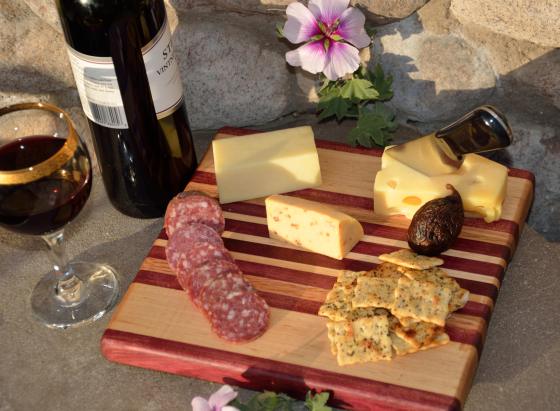
22 Cheese Boards are now ready for sale. All of the boards are approximately 8″ x 10″. All are unique. The most prevalent wood is hard maple, but I’ve also used purpleheart, yellowheart, red oak, cherry, walnut, mahogany, teak, padauk, jatoba and honey locust. They are all finished with mineral oil, and then a beeswax/mineral oil topcoat.

# 11 Cheese Board, $35. Jatoba, Hard Maple, Walnut.

# 10 Cheese Board, $30. Walnut, Padauk, Hard Maple, Red Oak.

# 18 Cheese Board, $40. Edge grain. Purpleheart, Hard Maple and (this one has) Red Oak. I’m no longer using Red Oak in this design.

# 8 Cheese Board, $30. Red Oak, Walnut, Yellowheart.

# 9 Cheese Board, $35. Red Oak, Purpleheart, Walnut, Hard Maple.

# 7 Cheese Board, $30. Hard Maple, Padauk, Walnut.

 I’ve been in a smaller mood lately.


