The casual dining area of the Kilauea Fish Market.
When we found the Kilauea Fish Market, we also found the best lunch on Kauai (read about the other great restaurants we’ve found on Kauai, here).
Unfortunately, we live on the mainland.
When we returned home, Velda began her quest to create an Ahi Wrap as wonderful as the one we found on Kauai. You can make her’s today … let us know how it stacks up against her inspiration when you get to Kauai!
Ahi Sauce Ingredients
1/2 tsp fresh grated ginger
2-3 cloves garlic
1 tsp mirin
1 tsp rice wine vinegar
2 T light soy sauce
1 T honey
1 drop hot sauce, or to taste
1-2 T sesame oil
mayo as needed for thickening
Ahi Sauce Instructions
Mix with immersion blender. Refrigerate overnight for the flavors to develop.
Add mayo to taste in order to thicken the sauce before serving.
Ahi Wrap Ingredients
2 large tortillas
10 oz ahi tuna
sesame seeds
cabbage, shredded
cucumber, thin sticks
carrot, thin sticks
green onion, thin strips
brown rice
salt, pepper
Ahi Sauce
Ahi Wrap Instructions
Season ahi with sesame seeds, salt and pepper. Sear for 1- 2 minutes on each side, depending on thickness. Let cool slightly and cut into 1/2 inch cubes.
Layer rice, veggies and ahi on tortilla. Drizzle sauce and roll up burrito style.
The cash will run out as soon as this month. The result of this bureaucratic gridlock could be the largest municipal bankruptcy ever.
The city can’t overcome the white flight that has lowered the tax base. Now, it’s trying to fix crushing problems with no money. Oh, and apparently its island is sinking, too. The New York Times offers no solutions.
All of those residents and businesses that fled the city aren’t coming back. City government? Still fiddling around while the cash is almost gone. Irresponsibility in governance is everywhere it seems.
2. No more Saturday mail, government dawdles
This issue has been around for a while … the US Postal Service could save billions by not delivering on Saturday. The USPS announced Wednesday they were unilaterally ending Saturday delivery, because Congress hasn’t told them they can’t do that this year. Previously, Congress has always specifically blocked the initiative, which they still could. For now, however, they haven’t said NO, so the Postmaster General has taken the initiative.
This week’s LA Times editorial blames the Republicans for mandating the USPS fund the retirement program for its employees. The vicious plot imagined by the LA Times is not seen by the Washington Post, which observes the bureaucratic nightmare is the problem:
Like Gulliver tied down by the Lilliputians, this supposedly independent, self-supporting entity answers to a presidentially appointed board, Congress, several labor unions and a regulatory commission — not to mention the demands of corporate mailers and, last but not least, the general public.
But what’s really to blame? Revenues are down 37% over the last 5 years. Losses last year were $15.9 billion. Any business – any business – would struggle with losing over a third of its revenue over 5 years. Add in a rigid cost structure with bureaucratic oversight, and you’ve got a mess. And we do.
Who’s for ending Saturday delivery? According to the NY Times, the American people. And, the Obama administration.
Here’s a piece from George Will about the controversy when we ended Sunday delivery – and it was just as controversial.
Personally, I am a supporter of sending and receiving mail, but have no problem with 5-day delivery to save money. As the saying goes, a billion here and a billion there … and soon, you’re talking real money.
3. 92% of electronic data is under two years old
Let that statement sink in a minute.
Almost all electronic information – 92% – has been created in the last two years. Imagine the profound differences in our world when data mining matures as a business. Feeling like you have lost some privacy? You ain’t seen nothing yet. And the perspective of one of the chief data miners is that by marrying databases, we aren’t even losing privacy, as it’s all anonymous!
Personalized ads are already popping up on cellphones and news feeds everywhere. It’s just a matter of time until that personalization adds geographic proximity and we’re confronted with ads from nearby stores specifically targeting us based on past behavior. We saw that in the 2002 film Minority Report, starring Tom Cruise. It was frightening then, and it’ll be frightening when it’s “normal.”
Gian Fulgoni was a co-founder of comScore; he’s definitely on the leading edge of getting this massive amount of data to work for companies. To see what he’s thinking about, read this fascinating piece about the priorities and progression of data, here.
4. Congressional drones object to the President’s drones
Here’s what the Washington Post has to say on the topic, here. And, some other views….
6. Rejoice when you find a single downstairs window unlocked.
7. Find tools to remove screen from unlocked window (revel in the discovery of a shovel and long BBQ tongs).
8. Insert shovel and pry screen off.
9. Discover the little flippy thing is out, which means the unlocked window will only open 2″.
10. (ed. note: you know)
11. Compare the cost of breaking a window vs. the humiliation of calling for help.
12. Check wallet. Decide to call for help.
13. Discover your Droid auto-updated overnight, and it now won’t work until you figure it out, log in and confirm some new settings.
14. (eye roll)
15. Call Little Girl to see if she can get you in the house. She hangs up laughing hysterically.
16. Call MrsMowry to see if she can get you in the house. Winner! Sit on the bench and wait.
17. Finish updating the phone.
18. Consider how cold you’ll be in 30 minutes (I know, I know, but it was in the 50s today. Brrrrr.).
19. Walk around the house to see how bad the yard is.
20. Look for a place to hide a key.
21. Remember the last time you were locked out of the house (a hot tub was involved, and it was not my fault. All I’m saying.).
22. Think about buying a hide-a-key.
23. Look for more places to hide a key.
24. Play games on the now-functional phone.
25. Put your hands in your pockets. It’s probably in the low 50s.
26. Thank MrsMowry for helping you. Watch as she steals a weird radish as compensation. It’s weird that it was in the fridge, it’s weird that she knew it was in the fridge, and it’s weird that she wanted it. But you now have your keys. Let it go.
27. Time passes.
28. MrsMowry spilled the beans to Mrs. Mowry. Weigh the advantages of getting even with MrsMowry against the possibility you’ll need her help again. Hmmmmm.
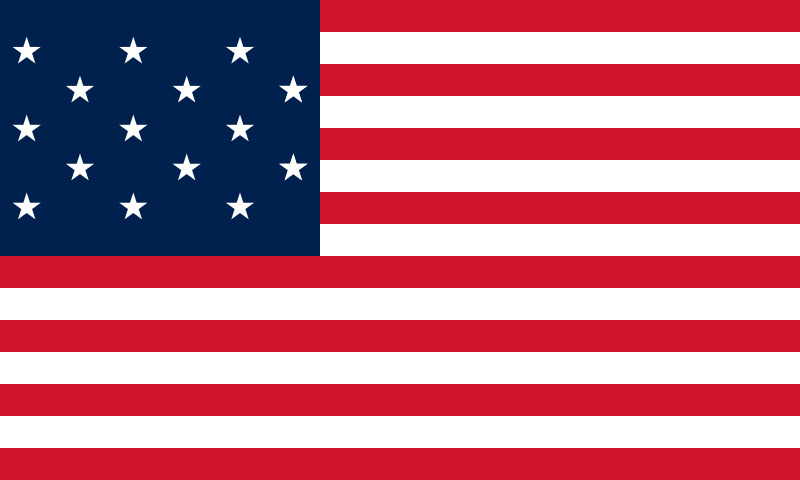
President George Washington signed into law the Flag Act of 1794. It changed the design of the US flag … we now had 15 states with the addition of Vermont and Kentucky, and needed an updated flag.
Five Presidents served under this flag: George Washington (1789-1797), John Adams (1797-1801), Thomas Jefferson (1801-1809), James Madison (1809-1817), and James Monroe (1817-1825)
This flag had 15 stripes and 15 stars, and would be the Star Spangled Banner seen by Francis Scott Key flying over Fort McHenry in 1814. Note that the circle of stars is gone … so perhaps in 1794, at least, the design of the Hopkinson flag was preferred over the Betsy Ross and Cowpens flags?
The Star Spangled Banner flag with 15 stars and 15 stripes.
“By Dawn’s Early Light” is the 1912 painting by Edward Moran showing Francis Scott Key on the morning of September 14th, 1814.
Key wrote the poem that become The Star Spangled Banner on the back of a letter he had in his pocket (see below!). The song was later set to a popular British tune, “The Anacreontic Song.” It was officially designated our national anthem by a congressional resolution, signed by Herbert Hoover in 1931.
The Star Spangled Banner
O say can you see by the dawn’s early light,
What so proudly we hailed at the twilight’s last gleaming,
Whose broad stripes and bright stars through the perilous fight,
O’er the ramparts we watched, were so gallantly streaming?
And the rockets’ red glare, the bombs bursting in air,
Gave proof through the night that our flag was still there;
O say does that star-spangled banner yet wave,
O’er the land of the free and the home of the brave?
On the shore dimly seen through the mists of the deep,
Where the foe’s haughty host in dread silence reposes,
What is that which the breeze, o’er the towering steep,
As it fitfully blows, half conceals, half discloses?
Now it catches the gleam of the morning’s first beam,
In full glory reflected now shines in the stream:
‘Tis the star-spangled banner, O! long may it wave
O’er the land of the free and the home of the brave.
Francis Scott Key’s original manuscript of his “Star-Spangled Banner” poem. It is now on display at the Maryland Historical Society.
And where is that band who so vauntingly swore
That the havoc of war and the battle’s confusion,
A home and a country, should leave us no more?
Their blood has washed out their foul footsteps’ pollution.
No refuge could save the hireling and slave
From the terror of flight, or the gloom of the grave:
And the star-spangled banner in triumph doth wave,
O’er the land of the free and the home of the brave.
O thus be it ever, when freemen shall stand
Between their loved home and the war’s desolation.
Blest with vict’ry and peace, may the Heav’n rescued land
Praise the Power that hath made and preserved us a nation!
Then conquer we must, when our cause it is just,
And this be our motto: “In God is our trust.”
And the star-spangled banner in triumph shall wave
O’er the land of the free and the home of the brave!
Best star picture I’ve seen in a long time! Thanks to Millard Fillmore’s Bathtub for finding it, and the National Park Service for originally posting it!
Here’s the truth: Betsy Ross didn’t sew the first American flag. Here’s more truth: no one really knows who created the first flag, but the smart money seems to be on Francis Hopkinson, a delegate to the second Continental Congress and a signer of the Declaration of Independence! He actually submitted a bill to the Congress for services rendered in designing the flag.
Which they refused to pay, as many people were involved in the design. According to Congress. And they never lie.
The Betsy Ross legend, come to find out, didn’t even become public until 1870, 34 years after her death and nearly 100 years after the American Revolution. The story was first presented in a paper by William J Canby, Ross’ Grandson, in a paper presented to the Historical Society of Pennsylvania. Canby declared that in early 1776, a secret committee from the Continental Congress came to Betsy Ross, a single mother running an upholstery business, to sew the flag based on a design George Washington sketched on Betsy’s table. The secret committee included Betsy’s uncle, George Ross, Robert Morris (perhaps the wealthiest man in America at the time) , and George Washington – who had the pew next to her at church.
The iconic moment, captured in many paintings, was when Betsy demonstrated to the gentlemen that rather than using the 6-pointed star that they proposed, a 5-pointed star would be better as it could be cut with one motion of her scissors.
But there’s no proof this ever happened, except for family stories passed down within the Ross family … which kept it a secret for almost a hundred years.
However, Canby’s story captured the imagination of America and it became a part of the public discourse … and was generally accepted as true. I learned it in school as fact. How about you?
The Basics
To figure out who made the actual first flag for the United States of America, there are a few basic questions to be answered.
1. When could such a flag have been made? Not before there was a nation, certainly. The Declaration of Independence was not ratified until July 4, 1776 … and Ross had received a commission to make the US flag months earlier? It seems difficult to designate a flag before you have a nation.
HOWEVER, historians have cited the “first” flag as the Continental Colors, which was used on both US ships (before there was a US) and at garrisons of the Continental Army. This flag was used until a more official flag was designated in 1777.
The Grand Union Flag, AKA The Continental Colors, was first hoisted on the ship Alfred, in Philadelphia on December 2, 1775, by Lt. John Paul Jones.
2. Who had the authority to create a flag to represent the country? A “secret committee” of the Continental Congress? I don’t think so. Even if Washington — the leader of our armed forces in time of war! — made the time to meet with a flag maker, it strains credulity to assume there would be no contemporary proof of the event. It’s also possible Washington simply needed a standard or battle flag for his army … that kind of flag has been very common through history. Armies “rally to the flag.”
3. Who designed it, and who made it? We’ll never know.
Finally, on June 14, 1777 the Continental Congress adopted the following: Resolved: that the flag of the United States be thirteen stripes, alternate red and white; that the union be thirteen stars, white in a blue field, representing a new constellation.
There was no provision for exactly how the stars should be arranged, nor what the size of each element should be. Those details varied in the subsequent years.
Here’s the “Betsy Ross Flag” that I grew up assuming was our nation’s first flag, along with two others that also fulfill the Congressional Resolution of 1777.
It’s true that Betsy Ross made flags, and may well have sewn this flag. Was it official? No more than the other contemporary designs that fulfilled the Continental Congress’ resolution.
This is the flag that Hopkinson billed Congress for the creation of. It certainly fulfills their requirements laid out in the June 1777 resolution.
The Cowpens Flag was said to have been carried by William Batchelor of the 3rd Maryland Regiment at the Battle of Cowpens, January 17, 1781.
Originally entitled Yankee Doodle, this is one of several versions of a scene painted by Archibald M. Willard in the late nineteenth century that came to be known as The Spirit of ’76. Often imitated or parodied, it is one of the most famous images relating to the American Revolutionary War. The life-sized original hangs in Abbot Hall in Marblehead, Massachusetts. The painting uses a Cowpens flag.
There is a belief among many that the first “official” US flag was raised at a summer-long encampment of the Continental army at Middlebrook, New Jersey in 1777. That flag is assumed to be the Hopkinson flag, not the Betsy Ross flag.
If the Continental Congress approved a specific version of the flag, that was never recorded. We do not know which design was the first accepted flag of the United States of America. That distinction was apparently not important to our founding fathers, and didn’t become important until truth seekers began to clamor for an answer about 100 years after the fact.
And that is frustrating. Life was much simpler in grade school, wasn’t it?
Betsy Ross showing Major Ross and Robert Morris how she cut the stars for the American flag; George Washington sits in a chair on the left. Painting by Jean Leon Gerome Ferris (1863-1930).
The Birth of Old Glory, by Percy Moran, has Betsy Ross showing her flag to George Washington and three other gentlemen. Painting was done circa 1917.
Charles Weisgerber’s 1893 painting of “The Birth of Our Nation’s Flag” helped make Betsy Ross one of the most famous women in American history. Since no images of Ross existed, Weisgerber created her face from photographs of her daughters and other female relatives. The publication of this illustration – in a book authored by Ross’ descendants, no less – cemented her place in American lore.
My Great Great Grandfather Baugher wore a chain on his vest, with his retractable brass toothpick attached. It’s a scary looking thing. The toothpick, I mean.
Old stuff.
This painting was done by my Great Great Aunt Alma Shull Parsons, and was given to my Mother and Father as a wedding present. It’ll never hang in a museum, but what a treasure!
The last time I visited Mom, we agreed that my next visit would include a session where we identified family heirlooms. Mom would tell the story. Sis would write the description. I’d take a picture, and then I’d combine those elements into one document. That way, we would always know what’s what, and what belonged to whom.
Simple, yes? Not really. You’ve got to find the time. I live 1,800 miles away. Sis is 200 miles away. Not. Simple.
At long last, the planets had aligned and we were ready. Mom proceeded to trot out a diverse lot of, uh, stuff. Let me be clear that we’re not talking about items with a high dollar value. We are talking about stuff that had been handed down from previous generations … like a brass toothpick owned by my Great Great Grandfather. Things that no one outside of my family would ever care about! But, oh my, what stuff Mom has!
I was amazed at how much I learned. You see, I’ve sat around Mom’s dinner table and talked about our ancestors. She’s got books and books and 3-ring notebooks of pictures and written records and birth certificates and service records and … STUFF … that we have discussed for hours.
We’ve got the family pictures and family tree documentation pretty well in hand (I hope).
Now, however, we’re learning about physical objects that rarely see the light of day … and now our entire family gets to know their story!
Pictures of my two favorite items are below. As you can see, it’s not about the monetary value, it’s about the family stories. The only way for you to capture those — the ONLY way — is to talk to your family members about what they know while you still have access to them. You never know when you’ll move away, or they’ll move away, or tragedy will strike and communication just won’t be possible anymore.
Find the opportunity to talk to your family members about what they know. You’ll find that the old stuff that’s lying around just might take on a whole new meaning for you when you know the history of each item!
Pocket watch? Not from my family!
This collapsible pocket shot glass was handed down, but we don’t know who owned it originally. Alas … but it sure does illuminate a fun heritage!
This graphic of a guardian angel (sorry for the poor photograph!) hung in the home of my Great Grandparents, James Woods and Matilda Rebecca Swartz Decker. It now hangs in Mom’s home.
Knowing Velda’s love of angels, Mom made this counted cross stitch of a Guardian Angel for Velda years ago, and it’s hung in our home since. I didn’t understand it was the same image as the one that hung in my Great Grandparents’ home until Mom told me last week!
The 31st President of the United States, 1929 – 1933
AKA: The Great Engineer, The Great Humanitarian, The Chief
From: Iowa, Oregon
College: Stanford University
Married to: Lou Henry Hoover
Children: Herbert, Jr., Allan
Party: Republican
Previous Jobs: Secretary of Commerce
In His Words: “You convey too great a compliment when you say that I have earned the right to the presidential nomination. No man can establish such an obligation upon any part of the American people. My country owes me no debt. It gave me, as it gives every boy and girl, a chance. It gave me schooling, independence of action, opportunity for service and honor. In no other land could a boy from a country village, without inheritance or influential friends, look forward with unbounded hope. My whole life has taught me what America means. I am indebted to my country beyond any human power to repay.”
“Older men declare war. But it is youth that must fight and die.”
“Let me remind you that credit is the lifeblood of business, the lifeblood of prices and jobs.”
“A good many things go around in the dark besides Santa Claus.”
“Being a politician is a poor profession. Being a public servant is a noble one.”
“Honor is not the exclusive property of any political party.”
“About the time we can make the ends meet, somebody moves the ends.”
“I’m the only person of distinction who’s ever had a depression named for him.”
“More than ten million women march to work every morning side by side with the men. Steadily the importance of women is gaining not only in the routine tasks of industry but in executive responsibility. I include also the woman who stays at home as the guardian of the welfare of the family. She is a partner in the job and wages. Women constitute a part of our industrial achievement.”
Not true: Hoover did not cause the Great Depression. He was in the wrong place at the wrong time, for sure. Some would say that he did more to end the Depression than his successors … some would say that it was only the economic expansion of WWII that ended the Depression. Hoover’s policies didn’t cause it, though, he was just caught in a bad economy.
True: Herbert Hoover was orphaned at the age of nine.
Hoover entered Stanford in 1891, in its inaugural year, after failing the entrance exams.
Hoover’s 1928 election slogan was “A chicken in every pot and a car in every garage.”
When the Great Depression hit, many of the homeless lived in towns of shacks called “Hoovervilles.”
Hoover was the first millionaire President.
Hoover and Taft are the only two Presidents without electoral experience or military service.
He approved the “Star-Spangled Banner” as our national anthem. It became the national anthem in 1931.
Hoover was a member of the Sons of the American Revolution; he was descended from Jacobus Wynne.
Hoover is the only President not to appear on the cover of Time during his Presidency.
Hoover was one of four Presidents to live to be 90.
The Official Portrait: Elmer W. Greene painted the official White Hosue portrait of Hoover in 1956.
The 8th President of the United States, 1837 – 1841
AKA:The American Talleyrand, The Careful Dutchman, The Enchanter, The Great Manager, The Master Spirit, Martin Van Ruin, Matty Van, The Mistletoe Politician, Old Kinderhook, The Little Magician
From: New York
College: One of 8 US Presidents that did not attend college
Previous Jobs: Lawyer, New York Attorney General, US Senator, Governor of New York, Secretary of State, Minister to the United Kingdom, Vice President
In His Words: “It is easier to do a job right than to explain why you didn’t.”
“The less government interferes with private pursuits, the better for general prosperity.”
“Those who have wrought great changes in the world never succeeded by gaining over chiefs; but always by exciting the multitude. The first is the resource of intrigue and produces only secondary results, the second is the resort of genius and transforms the universe.”
Not true: Van Buren was a political ally of Aaron Burr, a fellow New Yorker. A rumor about their relationship — that Van Buren was Burr’s illegitimate son — survived into the 20th century, when Gore Vidal included it in his novel, Burr. There was never any proof of a familial relationship.
True: Van Buren was the first President born a US Citizen.
He was also our first and only ESL President: the first President not to speak English as his first language. He grew up speaking Dutch.
He was the architect of the Democratic Party; after he organized it around his election, the party was firmly established as a national force.
Twentieth Century etymologist Alan Walker Read has published research asserting the wide usage of the phrase “O.K.” (okay) started during the presidential campaign and subsequent presidency of Martin Van Buren.
The Official Portrait: Chicagoan George P. A. Healy painted the official White House portrait of Van Buren. He received a Congressional commission in 1857 to paint portraits of several presidents, some of whom had sat for him in the 1840s. The portraits were of John Quincy Adams, Martin Van Buren, John Tyler, James K. Polk, Millard Fillmore and Franklin Pierce. Finished by 1859, the portraits were stored in the White House attic, as no funds had been provided for framing them. After the Civil War President Andrew Johnson obtained funding to frame them and hung the portraits in the Cross Hall.




 Martin Van Buren (1782 – 1862)


